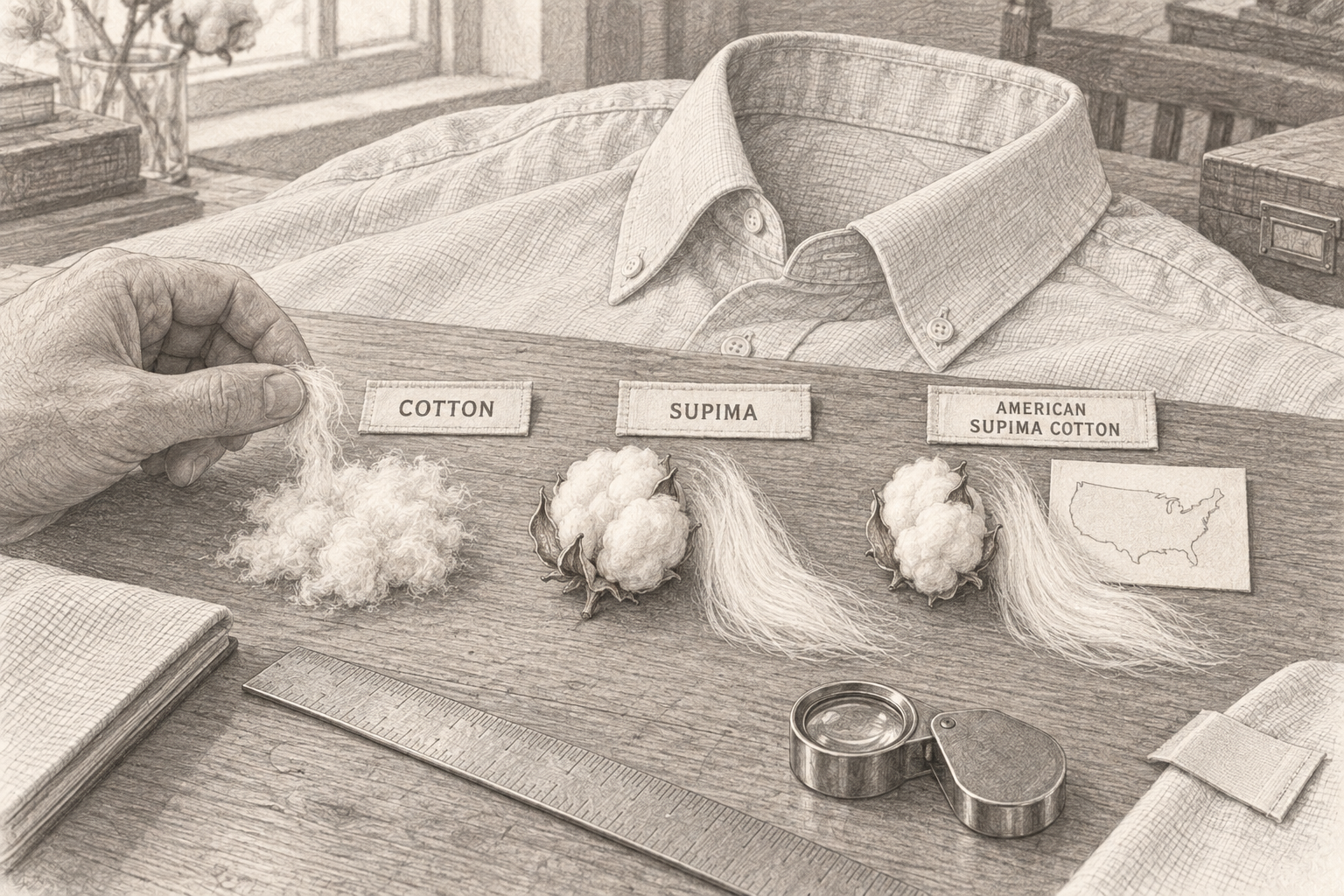
Brooks Brothers shirts may carry the words Cotton, Supima® Cotton, or “AMERICAN SUPIMA COTTON.” Placed side by side, they can look like steps in a quality hierarchy, but the three terms do not describe grades on the same scale.
Cotton is a type of fiber. Supima is a trademark that manages the type and origin of the raw cotton. AMERICAN SUPIMA COTTON explicitly states that American origin. The country where the fiber was grown and the country where the shirt was sewn are also separate pieces of information. Let us read each term on its own.
Cotton first tells us the type of fiber
Cotton is the generic fiber name used on material labels. Under US Federal Trade Commission rules, clothing must identify the generic names and percentages of its constituent fibers. “100% Cotton” therefore indicates, in principle, that the fiber composition is entirely cotton. Source: US FTC, “Calling It Cotton”
That statement alone does not tell us the cotton variety, fiber length, place of cultivation, yarn fineness, weave, finishing, or sewing factory. Two fabrics can both be 100 percent cotton and still look and feel different, as Oxford and broadcloth do. “100% Cotton” is a starting point for reading composition, not a quality ranking.
Supima is not a separate fiber from cotton
Supima® is a trademark for extra-long staple cotton grown in the United States. The Supima organization says it was founded in 1954 and that its name combines “Superior” and “Pima.” The cotton is now grown in California, Arizona, Texas and New Mexico, and products bearing the mark must use material from an authorized supply chain. Source: SUPIMA FAQ
The US Department of Agriculture distinguishes ordinary Upland cotton from Pima cotton, which has longer fibers. It is helpful to think of Supima as a brand identifying Pima cotton grown in the United States. Source: USDA ERS, “Cotton Sector at a Glance”
Pima cotton is therefore one type within cotton, while Supima identifies US-grown Pima cotton through a trademark and a management system. Not every cotton labeled Pima is Supima, and not every cotton labeled American Cotton is Supima.
Is “AMERICAN SUPIMA COTTON” a still higher grade?
There is no need to read “AMERICAN SUPIMA COTTON,” found on some older Brooks Brothers shirts, as a separate grade above Supima. American origin is already part of what Supima signifies. Placing AMERICAN before the name is most naturally read as making the US origin of the raw cotton explicit on the label.
Current Brooks Brothers product descriptions also use the phrase “American-grown Supima® cotton.” This is not the exact wording on the older label discussed here, but it is a present-day example of explaining US origin in another way. Brooks Brothers also appears in Supima’s official list of partner brands. Source: Brooks Brothers Supima dress shirt Source: SUPIMA brand list
The broader expression American Cotton should be kept separate. Many kinds of cotton other than Supima are grown in the United States. The word American on its own does not signify extra-long staple cotton or participation in the Supima trademark system.
American-grown cotton does not necessarily mean a Made in USA shirt
In AMERICAN SUPIMA COTTON, AMERICAN describes where the raw cotton was grown. It does not mean the same thing as Made in USA, which refers to the origin of the finished shirt.
For example, a Brooks Brothers Supima dress-shirt page describes the material as American-grown Supima while marking the product itself “Imported.” Cotton can be grown in the United States, made into yarn and fabric, and sewn into a shirt in another country. When examining a used shirt, do not infer US manufacture from the word American beside the material name; look for a separate country-of-origin label.
Supima does not always mean 100 percent cotton
The material name and the fiber percentages must also be read separately. A Brooks Brothers Supima piqué polo is labeled 100% Cotton. A stretch Supima dress shirt, by contrast, provides an example labeled 97% Cotton and 3% Spandex. Source: Brooks Brothers Supima piqué polo Source: Brooks Brothers Stretch Supima dress shirt
Supima supplies information about the cotton raw material used. To find whether the shirt contains another fiber, check the composition label listing percentages of Cotton, Spandex and any other fibers. The trademark label and the fiber-content label serve different purposes.
What long fibers can offer—and what the name alone cannot tell us
Supima explains that longer fibers can be made into finer, smoother yarn and associates them with strength, softness and color retention. Source: SUPIMA, “The Cotton”
The word Supima alone, however, does not determine every aspect of the finished garment. Yarn construction, fabric density and weave, non-iron finishing, sewing, and—for a used shirt—storage and wear all affect the actual feel and condition. The trademark is a valuable clue, but it is not a universal ranking that guarantees the overall quality of a shirt.
Read five kinds of information in order on an older shirt
When examining an older Brooks Brothers shirt, begin with the percentage of Cotton. Next, look for Supima or AMERICAN SUPIMA COTTON. Then check the country of origin of the finished garment, such as Made in USA or Imported; identify the fabric, such as Oxford or pinpoint; and finally examine the condition of the seams, collar and cuffs.
Supima’s current authorization system records the supply chain and verifies raw material, but today’s system cannot simply be applied retrospectively to an old shirt. Source: SUPIMA license information
Supima on an old label is meaningful information, but it should not be used by itself to determine a date or factory. Read it alongside the other labels. Doing so keeps three facts distinct: that the fabric is cotton, which raw material it claims, and where that material became a garment.
Cotton, Supima and American Supima Cotton: once their meanings are separated, a short label becomes a record of the path from raw material to clothing rather than just a promotional phrase.